

Bureaucratic Fiction
Narratives, Images, and Affects of Administration in Contemporary World Literature and Film (B-FILES)
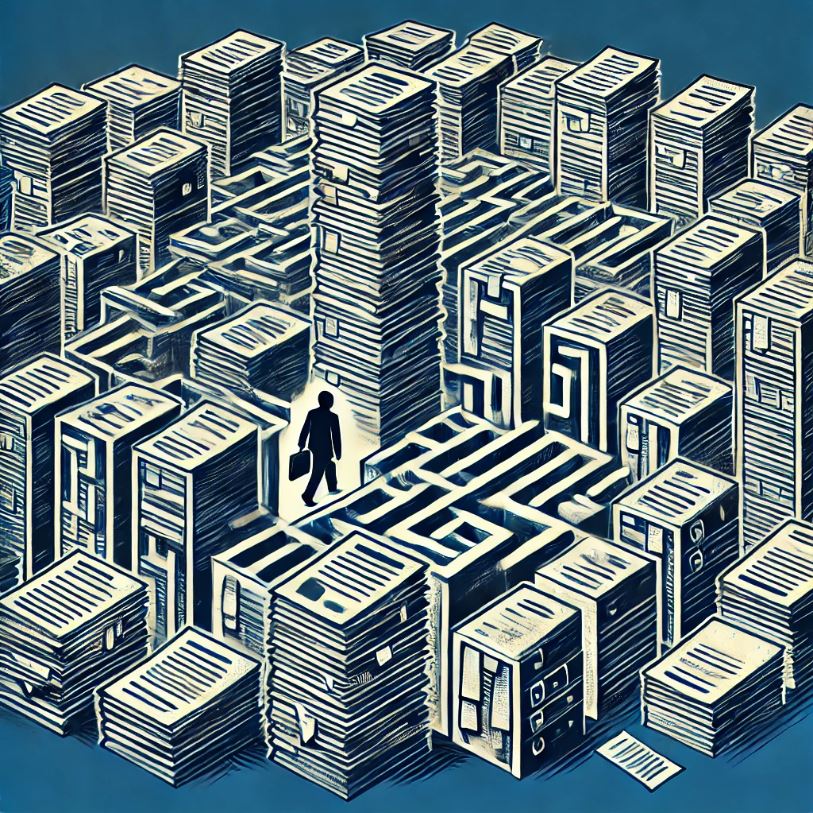
Bureaucracy is often perceived as dull, monotonous and cumbersome. Then why are stories about bureaucracy so compelling?
Aiming to provide an extensive answer to this question, along with an overview of bureaucratic fiction in contemporary literature and film, this research project led by Dr. Alexandra Irimia and hosted by Prof. Kerstin Stüssel runs from June 2024 until June 2026, with support from the Alexander von Humboldt Foundation.
LATEST:
Talks
June 2-3, 2026: "L’envers du formulaire : vers une poétique du risque non-assurable chez Benjamin Fondane" – Conference L'assureur dans la fiction, Université Paris 1 Panthéon-Sorbonne, France.
May 18-20, 2026: "Rule by Algorithm: A Bureaucratic Horror Story" – Conference Irrationality and the Age of AI: Language, Ethics, and the Future of Human Expression, Center for Science and Thought, University of Bonn, Germany.
Research Network
We've launched the Cultural Bureaucracy Studies Network! This initiative brings together researchers interested in the relationship between culture and bureaucracy, fostering collaboration at an international level, boosting the visibility of the field, and creating a space for dialogue and exchange. Stay tuned for upcoming events!
Press
- (DE) Die fabelhafte Welt der Bürokratie - Die Zeit Campus, reported by Katharina Meyer zu Eppendorf (Jan 22, 2026)
- (EN interview for Uni Bonn) In the Maze of Forms: The Curious Allure of Bureaucracy
- (DE interview for Uni Bonn) Im Labyrinth der Formulare: Die seltsame Anziehungskraft der Bürokratie
In the Making
- Bureaucratic Modernism (edited volume, co-edited with Dr. Jonathan Foster)
- proceedings volume for Paper Pushers and Ink Suckers: Objectifying the Administrative Subject in Bureaucratic Fiction (ACLA 2026, co-edited with Karolin Schäfer, Uni Kassel)
Abstract
B-FILES discusses fictional works engaging with bureaucratic themes and forms as concentrated, multi-layered illustrations of a broader ‘discourse network’ (Kittler) of contemporary administration, characterized by intricate linkages of political and symbolic power, technologies of data storage and encryption, signifying marks, bodies, and affective intensities.
It argues that the processes of regulation and systematization that produce flows of paperwork are not without consequence in the production of contemporary aesthetic forms. Conversely, these processes are always already determined by social imaginaries (Castoriadis) and historical narratives (Foucault) via the production and reception of aesthetic forms.
Finally, the project is an inquiry into the fictional and metafictional implications of logocentric authority, connecting the administrative force of the written record with its aesthetic potentialities.
Keywords
narratology
Goals
- theorize the concept of bureaucratic fiction
- establish a transnational corpus of works for analysis
- examine the social and political implications of fictional representations
- map and historicize bureaucratic fiction
Corpus
- transnational (world literature and cinema)
- set in public or private institutions
- engaging thematically and/or stylistically with institutions, office work, and bureaucratic forms
Research Questions
- How do literature and visual culture engage with the new work realities of the office?
- What contemporary works in world literature and cinema reflect bureaucratic themes and settings?
- What recurrent aesthetic strategies and formal patterns do they deploy?
- What changes if we conceptualize bureaucracy not only as an administrative apparatus, but also as an aesthetic phenomenon, a “discourse network” (Kittler), or an “affective arrangement” (Slaby)?
Methodology
- qualitative, transdisciplinary and multimedia approach
- main frameworks: comparative literature, media theory, cultural analysis
- secondary frameworks: history, political theory, administrative studies, sociology, gender studies
- case study analyses
- synchronic and diachronic comparisons
Results
database, articles, monograph, workshop, newsletter
International Symposium
Files, Forms, Fictions:
Literary Lives of Bureaucracy, from Ledgers to Algorithms
October 16th - 17th 2025
Bonn
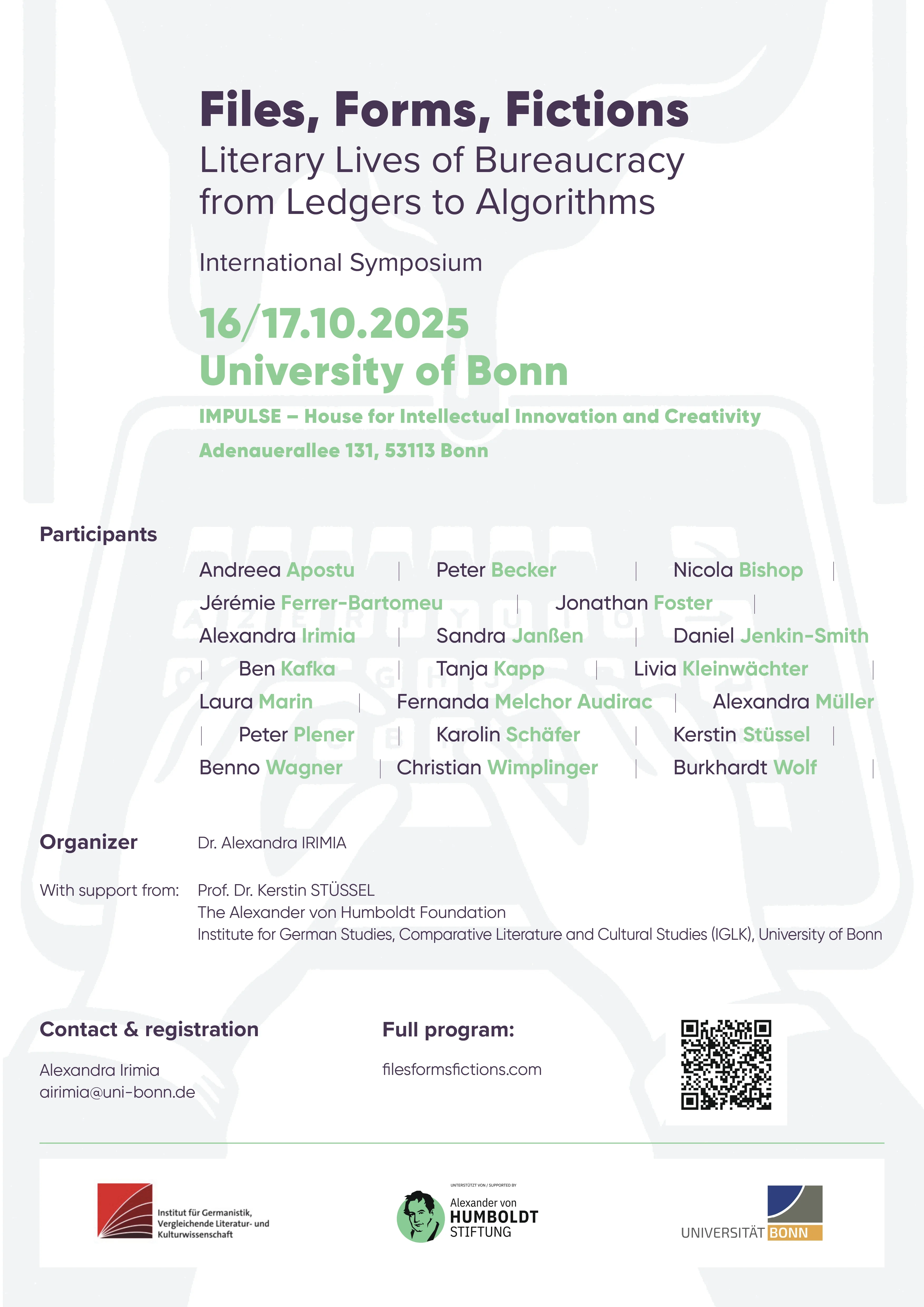
This international symposium brings together scholars exploring the intersection of bureaucracy and literature across various cultural and historical contexts. The main goal is to open a space for the circulation and exchange of ideas on the literary uses of bureaucratic forms and themes, as well as to sketch synchronic and diachronic comparisons.
Fostering a productive dialogue between researchers at various stages of their careers, with expertise in a variety of national literatures, specific themes, or individual authors, the event doubles as an opportunity to develop or consolidate frameworks for understanding literature’s complex relationship with bureaucratic power, documentation practices, and institutional acts, forms or tools of writing. At the heart of our exploration lies, therefore, the complex interplay between bureaucratic machinery and aesthetic imagination. We invite participants to illustrate their own approaches to how bureaucratic structures, languages, and logics have shaped fictional tropes (visual, textual, affective) while also considering how literature and the arts critique, reimagine, or reproduce administrative systems.
Of particular interest is the study of evolving bureaucratic structures and processes—with their intricate webs of political authority, computational technologies, symbolic markers, embodied experiences, and affective dimensions—which leave unmistakable imprints on contemporary aesthetic forms. We are currently witnessing a moment in which AI, platform capitalism, and data-driven systems reshape both bureaucratic structures and their cultural representations. As the early 21st century continues to accelerate the transition from paper-based recordkeeping to digital governance, we deem it important to look back at the fictional instantiations of 19th- and 20th-century models of administration for a better grasp of emergent forms of bureaucratic imagery and imagination.
Download the symposium program, the booklet with presentation abstracts and speakers' bios, and find out more at filesformsfictions.com.
Talks, Conferences, Presentations (upcoming)
-
June 2-3, 2026: "L’envers du formulaire : vers une poétique du risque non-assurable chez Benjamin Fondane" – Conference L'assureur dans la fiction, Université Paris 1 Panthéon-Sorbonne, France.
- May 18-20, 2026: "Rule by Algorithm: A Bureaucratic Horror Story" – Conference Irrationality and the Age of AI: Language, Ethics, and the Future of Human Expression, Center for Science and Thought, University of Bonn, Germany.
Talks, Conferences, Presentations (past)
2026
- March 12 - March 13, 2026: Project presentation at the 2026 annual conference of the German Postdoctoral Network (GPN), Munich, Germany.
- February 26 - March 1, 2026: "Seat Cushions, Hats, and Suits: Studies in Bureaucratic Objecthood" at the seminar Paper Pushers and Ink Suckers: Objectifying the Administrative Subject in Bureaucratic Fiction co-organized with Karolin Schäfer (Uni Kassel) at the 2026 ACLA Annual Meeting, Montreal, Canada.
2025
- November 13-14, 2025: "Labyrinths, Machines, Monsters: Visual Ciphers of Bureaucracy" – Workshop: Visuelle Chiffren in Bildender Kunst, Literatur, Film und anderen Medien, University of Heidelberg, Germany;
- October 27, 2025: "Paper Trails and Vanishing Acts: Permanence and Ephemerality of Bureaucratic Forms" – Workshop: Ephemeral Epistemologies and Encounters, University of Tübingen, Germany;
- October 16-17: International Symposium Files, Forms, Fictions: The Literary Lives of Bureaucracy, from Ledgers to Algorithms, University of Bonn, Germany;
- October 9-10, 2025: "Lem, Luhmann, and Organizational Boundary Collapse: Grenzstellen in Memoirs Found in a Bathtub (1961)” – Workshop Grenzstellen: Literary and sociological modelling of the organization/environment boundary – WEAVE project group “Bureaugraphies”, University of Cologne, Germany;
- June 30, 2025: "Bureaucratic Fiction: Aesthetic Regimes of Administration in World Literature and Film" – Colloquium talk, University of Konstanz, Germany;
- June 4-6, 2025: "Bureaucratic Fiction, Bureaucratic Scripts: Institutional Writing in The Palace of Dreams and The Beautiful Bureaucrat" – Acts of Writing: Cultural Practices, Knowledge Construction, Authorship, Justus-Liebig-Universität Gießen, Germany;
- June 1, 2025: "Misplaced Personality: Foucault’s Lives of Infamous Men and Bureaucratic Modernism" – ACLA Panel: Varieties of the Impersonal (online);
- May 27, 2025: "Forms, Files, Fictions: Stories of Bureaucracy in Popular Culture" – Ringvorlesung Italien: POP-Popkultur-Popliteratur, University of Bonn, Germany;
- May 20-23, 2025: "Habsburg Protocols at the Edge of the Empire: Wartime Bureaucracy Records in Forest of the Hanged" – WEAVE project “Bürographien. Administration after the Age of Bureaucracy”, Vienna, Austria;
- April 23, 2025: "Bureaucratic Fiction: Aesthetic Regimes of Administration in World Literature and Film" – IGLK Colloquium, University of Bonn, Germany;
- April 3, 2025: "Archive Fever and Other Symptoms of Bureaucratic Malaise: Pathologies of Public Office in 20th and 21st Century Dystopian Novels” – Workshop: Dystopian Narratives and Stories about Illness, CAPONEU, Nicosia, Cyprus;
2024
- November 20, 2024: “Bureaucratic Fiction: Narratives, Images, and Affects of Administration in Contemporary Literature and Film” – Humboldt Network Meeting, Friedrich-Alexander-Universität Erlangen-Nürnberg, Germany;
- October 3, 2024: “Vers une esthétique de la bureaucratie : le ‘grotesque administratif’ de Michel Foucault et ses avatars contemporains”. Rencontres doctorales – Centre Michel Foucault, IMEC-Abbaye d’Ardenne, Caen, France;
- June 6, 2024: “Bureaucracies of Memory. Institutionalized History in Four Contemporary European Novels”. Workshop: European Centres and Peripheries in the Political Novel, CAPONEU, ZfL Berlin, Germany.
Sign up to Bureaucritics
Substack newsletter with scholarship and art engaging with bureaucracy, created in collaboration with Jonathan Foster (Stockholm University).
Follow us for newsletter updates, stories about officialdom, and the strangely compelling world of its research.
All Issues
Researcher's Profile
Dr. Alexandra Irimia
Humboldt Research Fellow
Contact
Read More
Rule by Algorithm: A Bureaucratic Horror Story
Book Review
Alexandra Irimia reviewed Daniel Jenkin-Smith's book The Rise of Office Literature: Bureaucratization and Aesthetics in Britain and France, 1810–1900 (Bloomsbury, 2025) for Critical Inquiry.
Special Issue - Administory
Co-edited by Alexandra Irimia, Jonathan Foster and Burkhardt Wolf, a special issue of Administory: Journal for the History of Public Administration / Zeitschrift für Verwaltungsgeschichte themed "Administrative Cultures and Their Aesthetics" is now published.
Available in Open Access, the volume includes 17 contributions in English and German, along with an introductory study titled Looking Like an Administration: Towards an Aesthetic of Bureaucracy.
Working Paper & Book Presentation
The working paper "Bureaucracies of Memory. Institutionalized History in Four Contemporary European Novels" presented at the research workshop European Centers and Peripheries in the Political Novel (June 2024) is published on the CAPONEU project website. So is Alexandra Irimia's entry on Robert Menasse's Die Hauptstadt [The Capital], added to the database of European political novels.
Essay
Alexandra Irimia has published an essay on the anti-bureaucratic rhetoric of populism in the context of the 2025 Romanian presidential elections in the Romanian magazine Scena9.